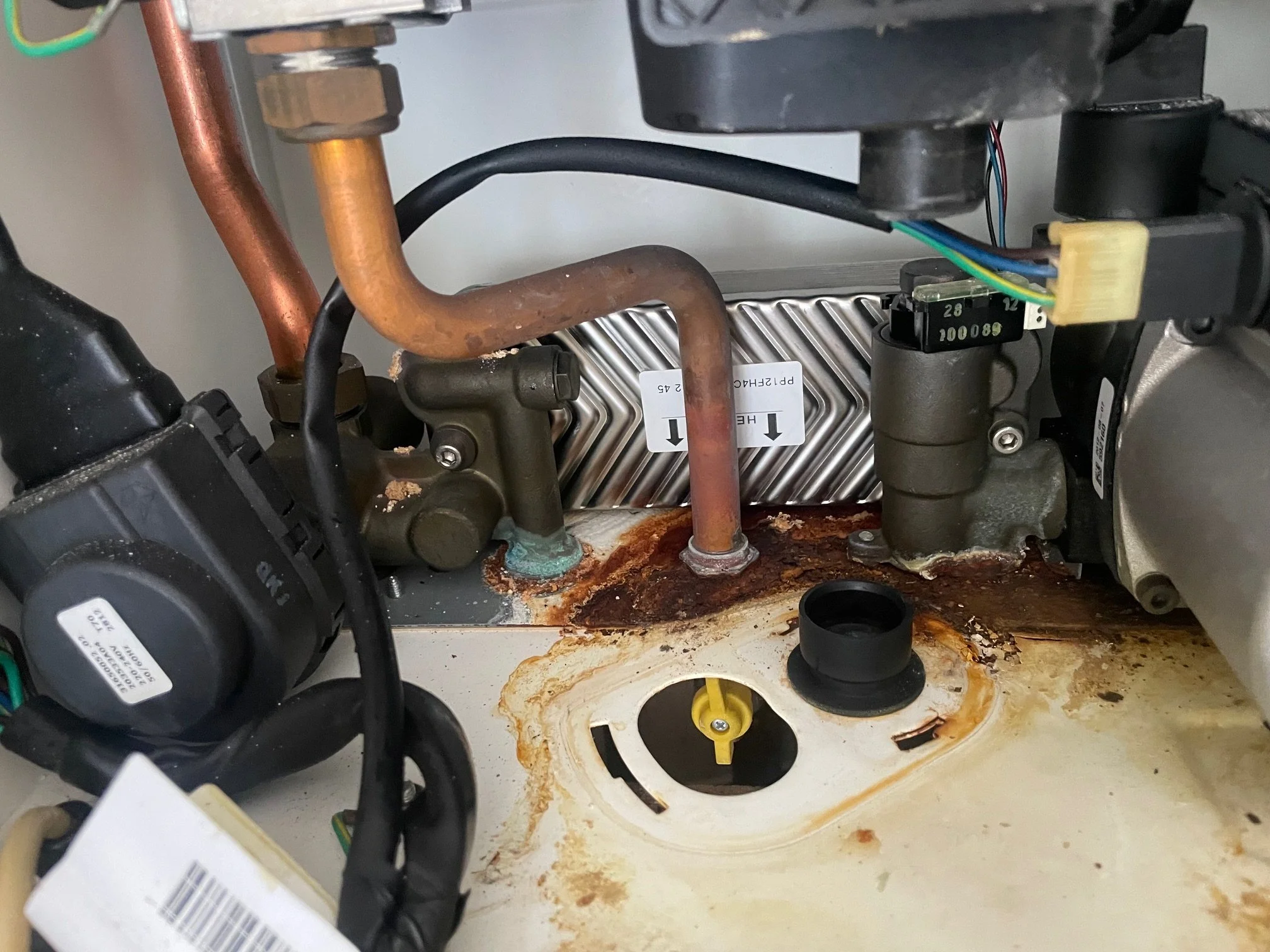
Rust under your boiler. A faint smell of acidity. Brown staining around the bottom of the casing. These are signs of a cracked sump, a known weakness on certain Ideal Logic models. Caught early, it's manageable. Left too long, it usually condemns the boiler.
What is the sump and why does it crack?
The sump is a plastic component inside the boiler that collects condensate, the acidic water produced as a by-product of the gas combustion process. From the sump, the condensate runs out of the boiler through the condensate pipe and into a household drain.
On certain Ideal Logic models, particularly older units that have been running for several years, the sump can develop hairline cracks. The cracks are usually invisible from the outside. The condensate then leaks out of the sump and runs onto the metal chassis of the boiler instead of going down the drain.
This matters because condensate from a gas boiler has roughly the same acidity as lemon juice (a pH of around 3 to 4). It's mildly corrosive to metal. Day after day, week after week, leaking condensate slowly rots the chassis, the base plate, and any metal components it touches.
The warning signs
If you have an Ideal Logic and any of the following are true, it's worth getting a Gas Safe engineer to take the case off and have a look:
- Rust or brown staining on the base of the boiler casing, especially around the bottom edge. This is the most reliable early warning
- Yellowing or white mineral deposits on internal components, where the acidic condensate has dried after escaping. Often visible around the base of the heat exchanger or below the sump itself
- A faint acidic smell near the boiler. Not strong, easy to miss, but distinct from any other normal boiler smell
- Wet patches or watermarks on the floor or wall behind the boiler
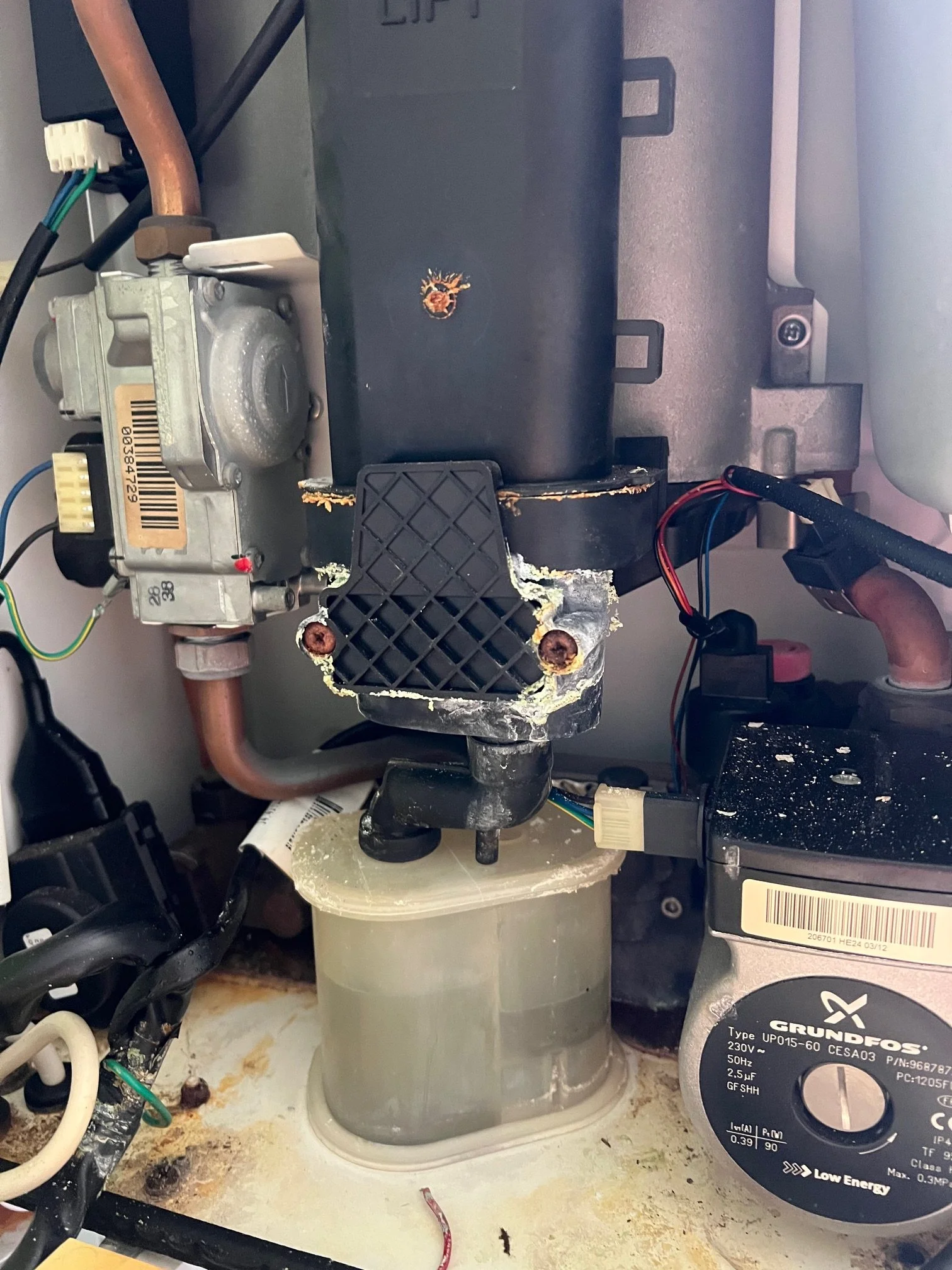
- Visible corrosion on screw heads, mounting brackets, or the gas valve base when the casing is removed
Important: Do not remove the boiler casing yourself to check. Boilers contain live gas connections and a high-voltage electrical supply. The case should only be removed by a Gas Safe registered engineer.
What it looks like when it's gone too far
By the stage shown in the close-up photo, the boiler is usually beyond economic repair. The plastic sump itself is visibly cracked and distorted. Corroded screw heads and yellowing mineral deposits around the joint show how long the leak has been going on.
The damage isn't limited to the sump. Once condensate has been escaping for months or years, the chassis is rotted (visible in the wider shot at the top of this article), the gas valve base may be corroded, and electrical components may be compromised. Replacement parts cost more than a new boiler is worth.
What to do if you think you've got one
If you're an Ideal Logic owner and you've noticed any of the warning signs above, get it looked at sooner rather than later. The earlier a cracked sump is caught, the more options you have.
If caught early
If the sump is cracked but the chassis hasn't yet been damaged, the sump itself can be replaced as a part. The boiler keeps running, and the underlying issue is fixed. This is the best outcome.
If left too long
If the chassis has been corroded by months or years of condensate leakage, the boiler is usually beyond economic repair. Even replacing the sump won't undo the structural damage. In this case, replacement is the honest recommendation.
How we'd handle it
The £99 call-out covers diagnosis. You'd get an honest answer on whether replacement is needed or whether a sump replacement will keep the boiler running. If replacement is the right call, we'd talk through which Ideal model is the closest like-for-like (or whether a different brand would suit your home better) before any commitment to a new boiler.
Why we mention this issue specifically: Cracked sumps are a known and recurring fault on certain Ideal Logic models, particularly the earlier generation. Other brands have their own characteristic faults, but on Ideal Logic this is one of the more common reasons we end up condemning a boiler that the owner hoped to repair. Catching it early gives you the option to keep the boiler going. Catching it late doesn't.
Related advice
If you're not sure whether what you're seeing is a sump issue or something else, our boiler repairs page covers the most common boiler faults and what each typically costs to diagnose and fix.