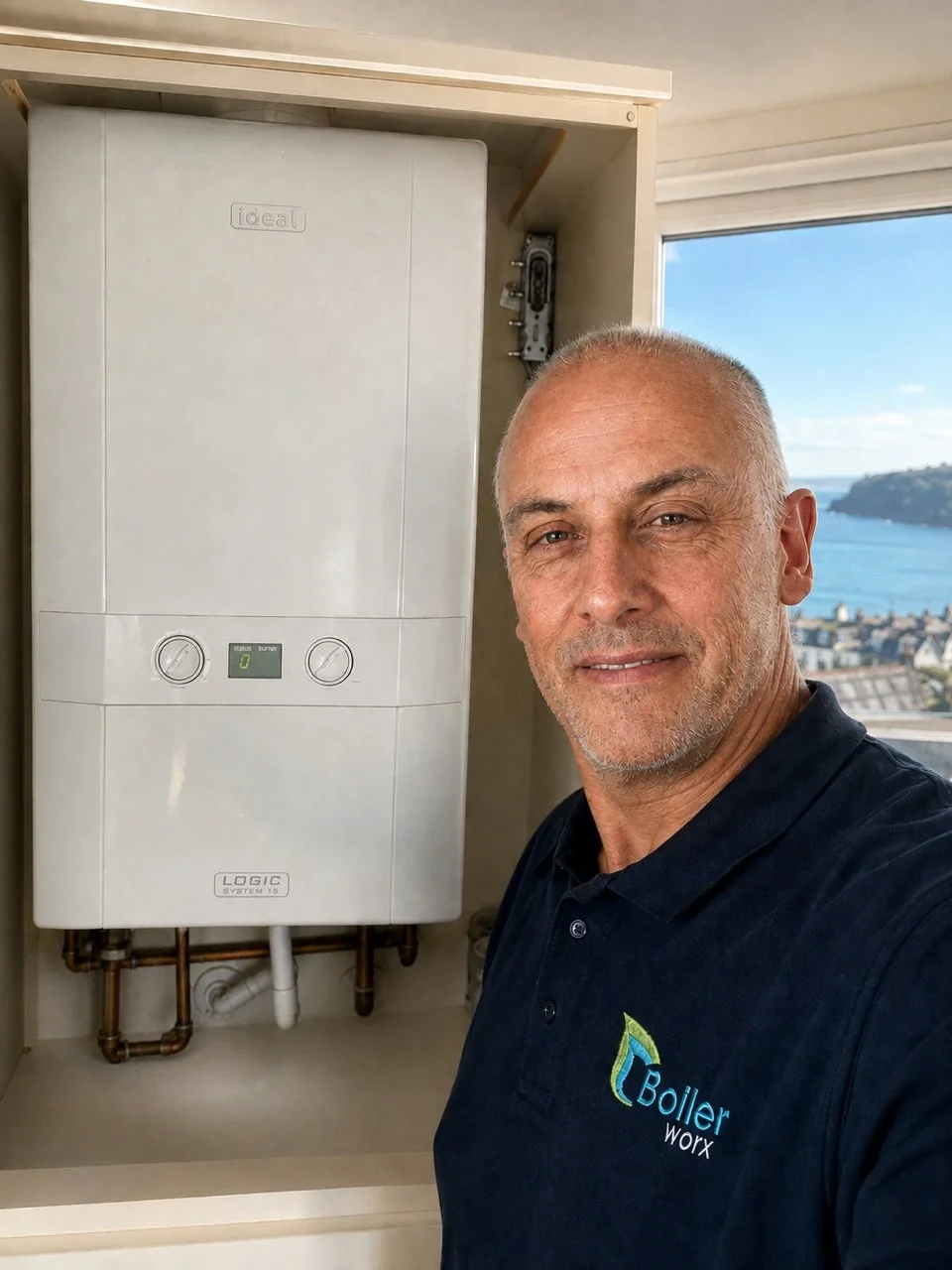
Water pooling under the bottom-left of a Worcester Greenstar boiler. Sometimes a steady drip, sometimes so fine you need a torch to see the spray. The system pressure stays normal. This is a common fault on the Junior, CDi, and I-Series, and it usually means a pinhole in the flow manifold.
The symptom
You'll notice one or more of:
- Water under the boiler, dripping from the bottom-left corner. Sometimes obvious. Sometimes a fine spray that's only visible if you shine a torch into the underside of the boiler with the casing off
- White or chalky residue on the bottom of the boiler casing or on whatever's underneath. The dried mineral trail from a slow-running leak
- Pressure gauge reading normal. This is the giveaway. Most boiler leaks drop the pressure. This one doesn't
- The leak getting worse over time. A pinhole that started as a drip can become a steady drip and eventually a small spray
Why the pressure doesn't drop
This is the part that confuses owners. Most boiler leaks drop the system pressure. Why doesn't this one?
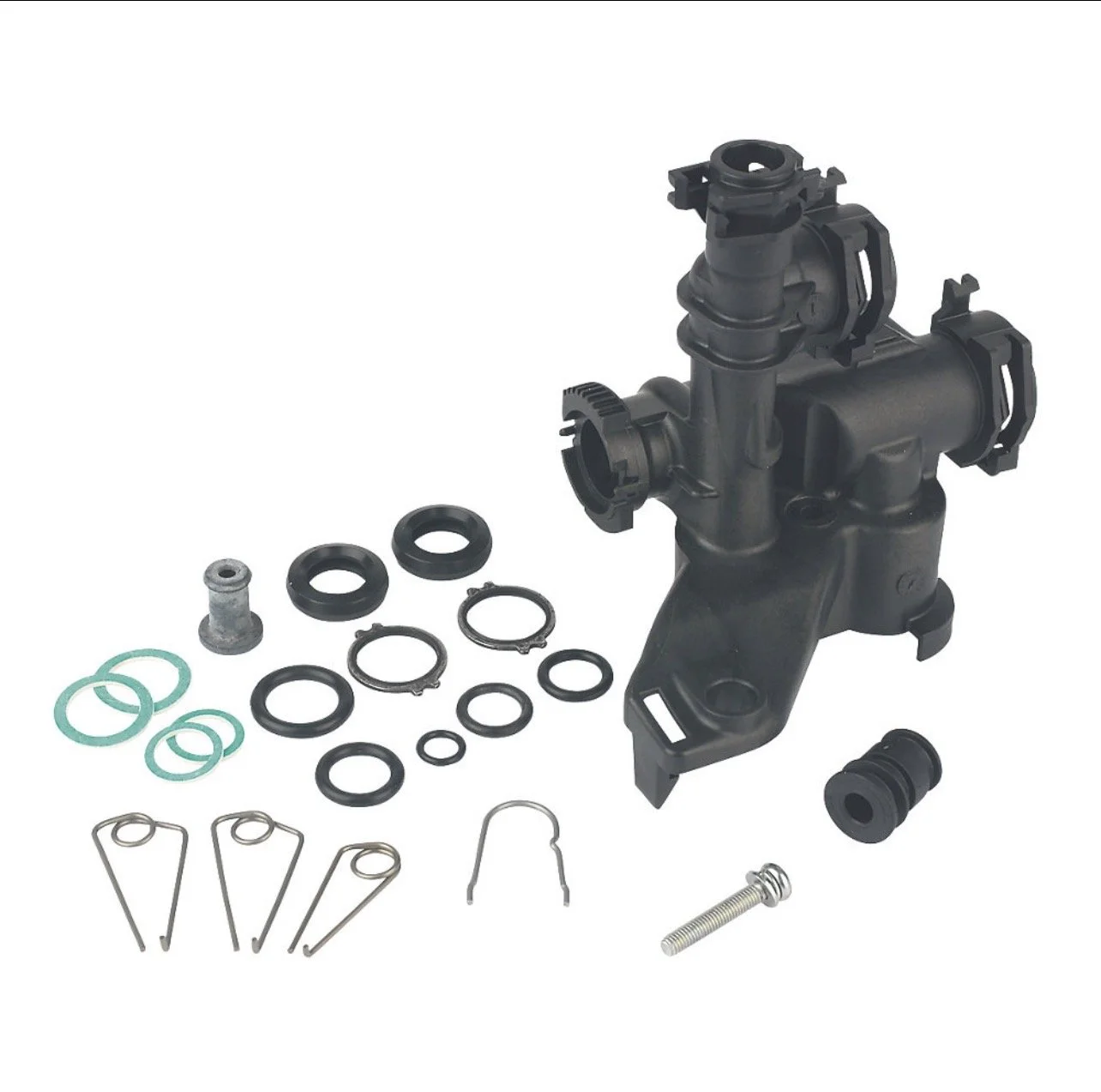
The flow manifold (Worcester sometimes calls it the "flow unit") sits on the cold mains-water side of the boiler, before the water gets heated. It's effectively part of your domestic hot water plumbing rather than the sealed central heating loop. When the manifold develops a pinhole, the water that escapes is mains-pressure water from the cold supply, not heating system water.
That means the pressure gauge on the boiler stays at its normal 1.0-1.5 bar reading because the sealed heating loop is still intact. But the leak keeps going as long as the mains supply is open, and unlike a heating-side leak that stops when the system pressure drops to zero, this one will run until you turn off the water.
Why it happens
The flow manifold on Greenstar boilers is made of plastic. It's been the same component on the Junior, CDi, and I-Series since the early Greenstar models launched around 2005. Over years of heat cycles and pressure exposure, the plastic becomes brittle and develops hairline cracks or pinholes. It's a known weakness on the platform.
The fault tends to show up after 10 to 15 years on a typical installation, though it can happen sooner on systems running at the upper end of their pressure range, or later on systems that haven't been worked hard.
What to do if you spot it: Isolate the cold water supply to the boiler. There's usually an isolation valve on the cold water inlet pipe underneath the boiler. Turning it off stops the leak immediately. The boiler will run on heating only until the manifold is replaced. Then call us.
What's involved in the fix
The flow manifold itself is an inexpensive part. The labour is the awkward bit.
Replacing it means:
- Draining down the boiler completely
- Disconnecting five separate connections: the main heat exchanger, both connections to the plate heat exchanger, the domestic hot water connection, and a sensor connection
- Removing the hydraulic block to access the manifold
- Fitting the new manifold with new O-rings (the part comes with all the seals required)
- Reassembling, refilling the system, pressure-testing for leaks, and confirming everything's working
The job is straightforward in theory but fiddly in practice. Worcester's design doesn't leave much room to manoeuvre, and on older units the copper pipework can be stuck to the manifold by perished O-rings, which makes separation harder. A clean job takes around an hour. An awkward one can take 2 to 3 hours.
What it costs
The manifold is an inexpensive part, so most of the cost is the labour, and that depends on how cooperative the existing pipework is once disassembly starts. Diagnosis happens first under the standard call-out, after which you get a clear quote before any repair work goes ahead. Current call-out pricing is on the boiler repairs page.
Is it definitely the manifold?
A few other possibilities for water at the bottom-left of a Worcester Greenstar:
- Other pipe joints in the same area. The bottom-left has several connections close together, and a leaking joint can look like a manifold leak from the outside
- Plate heat exchanger seals. If the seals around the plate exchanger have failed, water can escape and run down the same path
- The pressure relief valve discharge pipe, if it runs externally on the left-hand side. A failed expansion vessel can cause the PRV to weep
Diagnosis with the casing off takes around 10 minutes. Once the source is confirmed, the fix is straightforward.
Related advice
If you're seeing a slow water leak elsewhere on the boiler, our article on slow leaks and the automatic air vent covers a different common cause that does drop the system pressure.