Most modern boilers will show a fault code for flame failure, but the code itself tells you very little. It means one of two things. Either the boiler has tried to ignite and no flame was produced, or the boiler was running normally and the flame has been lost. What it does not tell you is why, and the list of possible causes is longer than you might expect.
Why this fault is so hard to pin down
Flame failure is one of the vaguest faults a boiler can throw. Several different components can produce exactly the same code, and they range from a two-minute adjustment to an expensive part replacement. Getting the diagnosis right first is the difference between a modest repair bill and spending hundreds of pounds replacing parts that were never the problem.
The ignition side: making the spark
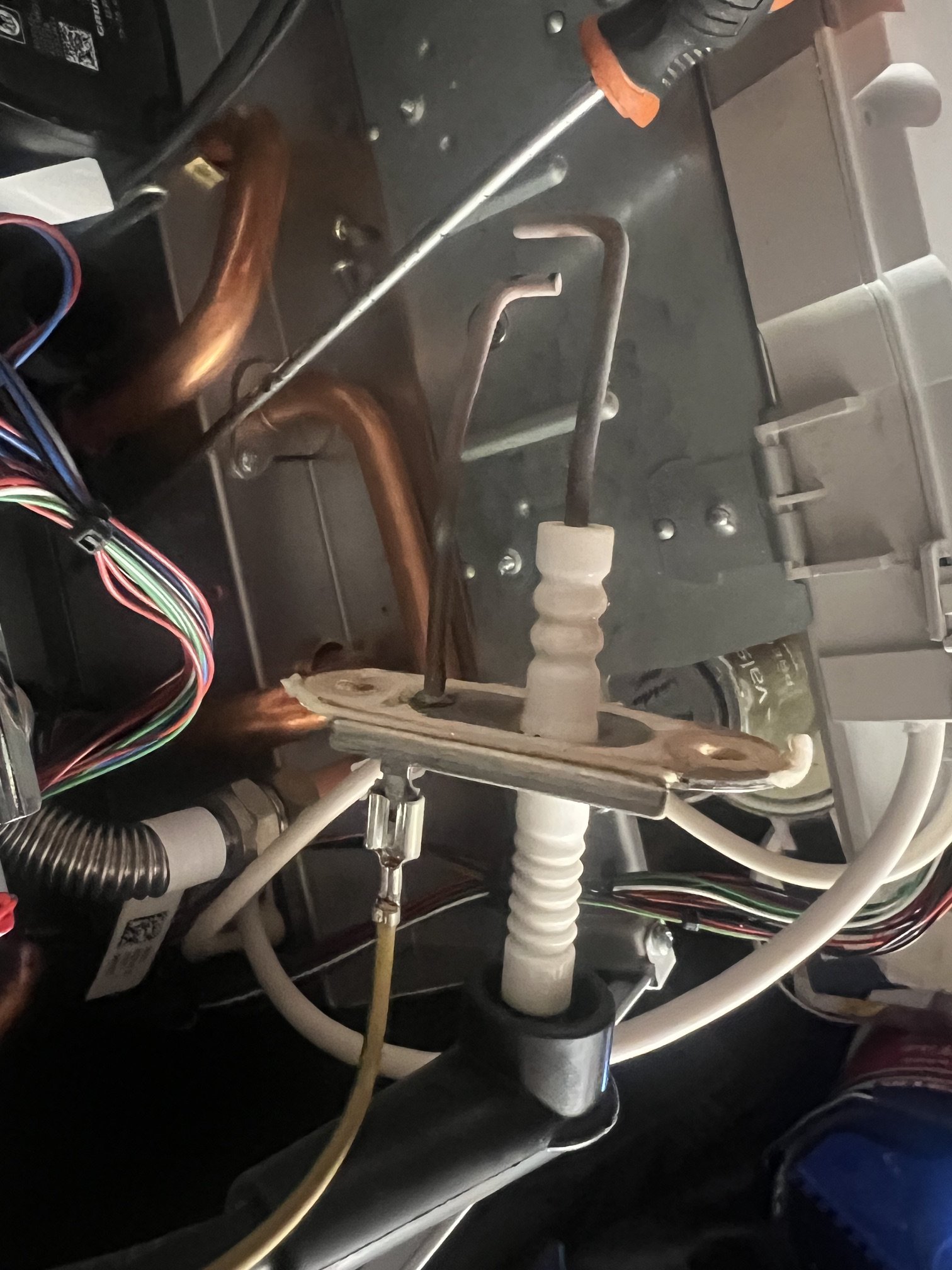
The first thing worth checking is the ignition electrodes. These create the spark that ignites the gas in the combustion chamber. Most electrodes need a gap of around the thickness of a pound coin. If the gap is too close or too far apart, no spark.
The electrodes get their power from the ignition module, sometimes called the spark generator. If the module has failed, again there will be no spark. The module connects to the electrode by a lead, similar to an HT lead on a car, and these leads can wear or the connectors can work loose over time.
One step further back, the ignition module gets its signal to fire from the boiler's PCB, the printed circuit board. A fault on the board means no signal, no spark, no flame.
On most boilers the ignition module is a separate part and straightforward to replace. On some older boilers it is built into the PCB itself, and that can make the repair very costly.
The sensing side: proving the flame exists
You might think that is already a lot to diagnose. There is more.
The boiler confirms it has a flame using a flame sensing electrode, sometimes called a flame rectification electrode. Here is the catch. The boiler could be igniting perfectly and burning cleanly, but if the sensing electrode fails to send the correct signal back to the PCB, the boiler shuts down anyway and reports flame failure. A healthy boiler locked out by a faulty sensor.
Testing it means measuring the tiny signal that travels from the electrode to the PCB. The AC current sent to the ignition electrodes jumps through the flame and transforms, by what might as well be witchcraft, into a small DC signal. That DC signal is the boiler's proof that a flame exists.
To make the job harder still, some manufacturers route this signal through the condensate trap or an overheat stat, so a fault in either of those can interrupt the signal and trigger the same flame failure code.
The other suspects
Two more components can produce the same fault. A fan that is not running, or running at the wrong speed, will stop the boiler from firing. So will a gas valve that fails to open. Both are more easily diagnosed than the electrode and signal faults above, and both are relatively simple to replace, though neither part is cheap.
Any work on the gas side of a boiler must be carried out by a Gas Safe registered engineer. If your boiler is showing a flame failure code, do not remove the casing or attempt to adjust electrodes yourself.
The short version
One fault code, at least seven possible causes:
- Ignition electrodes, worn or with the spark gap out of tolerance
- Ignition lead, worn insulation or loose connectors
- Ignition module, failed and producing no spark
- PCB, not sending the signal to fire, or misreading the flame signal
- Flame sensing electrode, shutting down a boiler that is actually burning fine
- Fan, not running or running at the wrong speed
- Gas valve, failing to open
Some cost pennies to fix. Some cost hundreds. Guessing at the cause and replacing parts one at a time is the expensive way to find out which one you have. Proper diagnosis first is the cheap way.